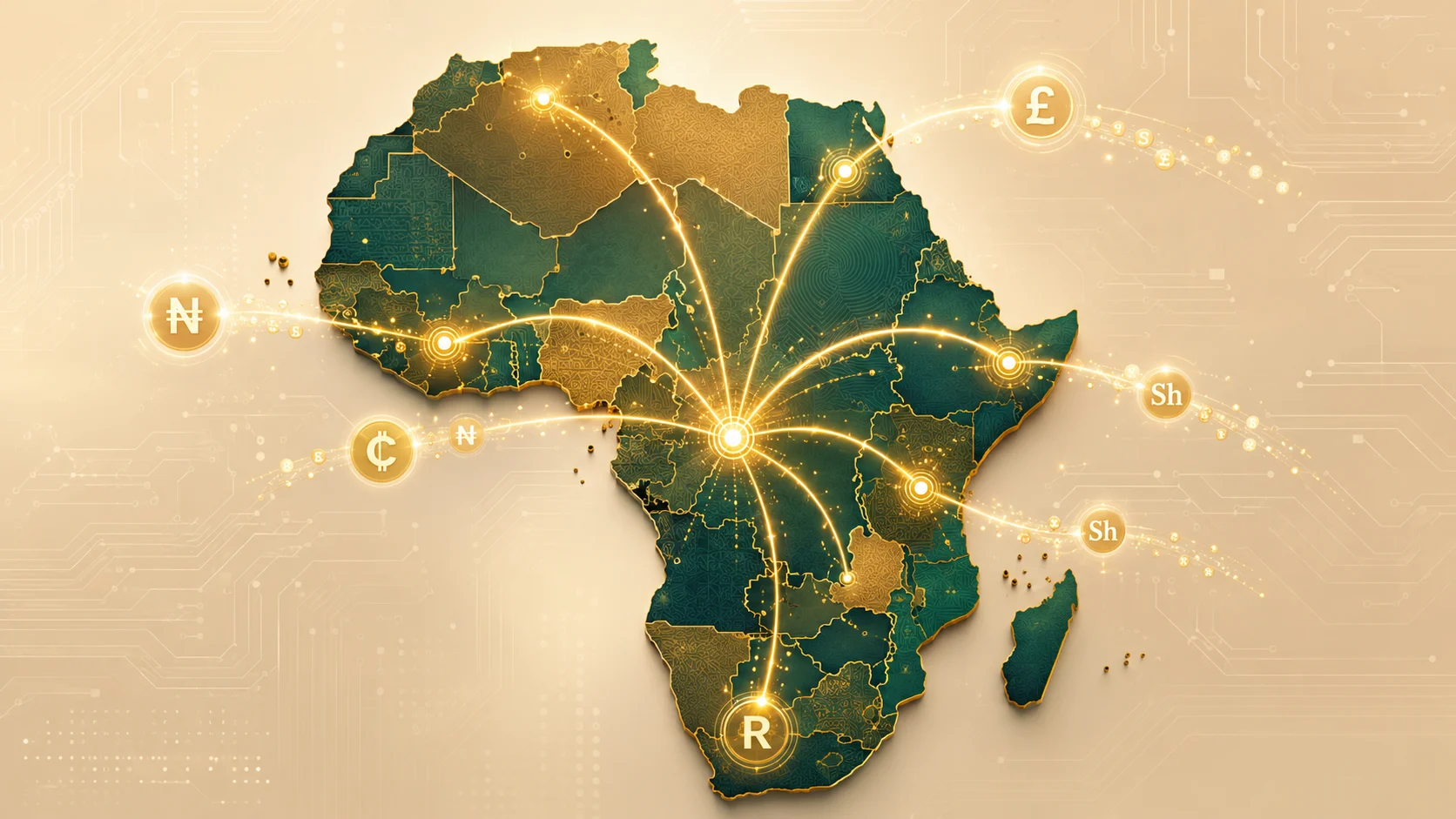
Cross-border payments between African countries have long been slower, costlier and more dollar-dependent than they need to be. PAPSS is the continental infrastructure built to change that — and this guide explains, in plain terms, what it is, how it works, who runs it, what it costs, where it falls short, and where it is heading.
Figures in this guide are current as of June 2026 and are updated periodically. Country and bank counts move as the network grows; where a number is an estimate, it is attributed.
What is PAPSS?
PAPSS — the Pan-African Payment and Settlement System — is a continental financial market infrastructure that lets a person or business in one African country pay someone in another African country in local currency on both sides. The sender pays in their own currency; the recipient receives in theirs; and the payment is cleared and settled between the two countries' banking systems without first being converted into US dollars or euros and routed through a correspondent bank outside the continent.
It is not a consumer app and not a private fintech. PAPSS is an initiative of Afreximbank (the African Export-Import Bank), developed in collaboration with the African Union and the AfCFTA Secretariat — the body that administers the African Continental Free Trade Area. It went live commercially in January 2022 after a successful pilot in the West African Monetary Zone, and it is led by chief executive Mike Ogbalu III. In practical terms, PAPSS is the payments layer designed to make the AfCFTA's single market actually function: if goods, services and people are meant to move freely across African borders, money has to move freely too.
The system is built with central banks, not around them. Participating central banks connect their national real-time gross settlement (RTGS) systems to PAPSS and settle their net positions with one another, while Afreximbank acts as the settlement agent and provides settlement guarantees. That central-bank backing is the credibility anchor that distinguishes PAPSS from a purely commercial payment scheme.
The problem PAPSS solves
To understand why PAPSS matters, picture a Nigerian importer paying a supplier in Kenya before PAPSS existed. The naira payment could not move directly to a Kenyan shilling account. Instead it was converted into US dollars, sent through a correspondent bank — typically in Europe or North America — converted again into shillings, and finally delivered. Each hop added a foreign-exchange spread, a fee, and time. A transfer that should take seconds could take two to four working days, and a meaningful slice of the value was lost along the way.
This "correspondent banking detour" had three compounding costs. First, money: every conversion carried an FX margin, and intra-African remittances have historically been among the most expensive in the world, with sub-Saharan routes often cited at around an 8% average cost to send. Second, time: multi-day settlement ties up working capital and makes trade unpredictable. Third, dollar dependence: because the dollar sat in the middle of nearly every cross-border African payment, the continent's trade was exposed to dollar liquidity shortages and external banking relationships it did not control. By some estimates, African economies were losing on the order of several billion dollars a year to these intermediation costs — a figure commonly cited as around US$5 billion annually, though precise numbers vary by source and methodology.
PAPSS's core idea is simple to state and hard to build: keep the payment, the foreign exchange, and the settlement on the continent. When a payment never leaves Africa's own banking rails, the dollar leg disappears, the correspondent fees disappear, and settlement collapses from days to seconds.
How PAPSS works
PAPSS runs on three linked processes. Understanding them is the difference between treating PAPSS as a black box and seeing why it is fast, final and trustworthy.
1. Instant payment
A customer instructs their bank or payment service provider to send money, denominated in their local currency, to a recipient in another African country. The instruction is passed into PAPSS, which performs the necessary compliance, sanctions-screening and legal checks inside the system and routes the message to the recipient's bank. The recipient's bank credits the beneficiary in their local currency. From the user's point of view it is near-instant: PAPSS targets completion in under 120 seconds, and the credit to the recipient is immediate and irrevocable — once it lands, it cannot be clawed back, which is what makes it safe to release goods against a received payment.
2. Clearing and pre-funding
Behind that instant credit sits a clearing arrangement. PAPSS distinguishes between Direct Participants — typically banks that integrate directly and settle through their central bank's RTGS system — and Indirect Participants, which reach the network through a Direct Participant. Participants pre-fund or maintain positions so that the instant credit a recipient sees is backed by real liquidity in the system rather than an unfunded promise.
3. Net settlement
Individual payments are not settled one by one between central banks; that would be impractical at scale. Instead PAPSS nets all the day's flows and settles the net positions between participating central banks once a day, at 11:00 GMT. Afreximbank stands behind this settlement as agent and guarantor. Throughout, PAPSS uses the ISO 20022 messaging standard — the modern, data-rich global standard for financial messaging — so that payment instructions carry structured information and interoperate cleanly with banks' existing systems.
The combination is what gives PAPSS its character: instant and final for the user, netted and central-bank-settled underneath.
The PAPSS product family
PAPSS began as a single instant-payment rail but has grown into a family of services, especially across 2025 and 2026.
- PIP — PAPSS Instant Payment. The core rail described above: account-to-account cross-border payments in local currency.
- PAPSSCARD. Launched in June 2025 in partnership with Afreximbank and Mercury Payment Services, PAPSSCARD is the first pan-African card scheme — an African alternative to Visa and Mastercard for intra-African card payments, designed so that a card transaction between two African countries can be authorised and settled on African infrastructure rather than routed offshore.
- PACM — PAPSS African Currency Marketplace. A marketplace for exchanging African currencies directly against one another, enabling price discovery between African currency pairs without using the dollar as an intermediary. PACM addresses one of the hardest parts of intra-African payments: finding a fair, liquid rate between, say, the Ghanaian cedi and the Kenyan shilling.
- Overlay services. On top of the core rail, PAPSS offers value-added services including Request to Pay, Escrow, Remittance, proxy addressing (paying to an alias such as a phone number rather than a full account number), and sanctions screening.
Together these turn PAPSS from a single pipe into a stack: a way to pay, a card to pay with, and a marketplace to source the currency.
Which countries and banks use PAPSS
As of 2026, PAPSS connects more than 19 countries, works with 150-plus commercial banks, and is integrated with 14 regional payment switches — the national or regional systems (like Kenya's Pesalink or Nigeria's NIBSS) that already route domestic payments. The network's stated ambition is large: connection to roughly 500 million bank accounts across 30 countries, which would make it one of the most widely reachable payment systems on the continent.
Live and connecting markets span every region of Africa. They include:
| Region | Markets connected or connecting (as of 2026) |
|---|---|
| West Africa | Nigeria, Ghana, Guinea, Sierra Leone, Liberia, The Gambia |
| North Africa | Egypt, Morocco, Algeria, Tunisia |
| East Africa | Kenya, Rwanda (via Bank of Kigali), Djibouti |
| Southern Africa | Zambia, Zimbabwe, Malawi |
| Island states | Comoros |
The exact roster moves as central banks and banks join, so the count above should be read as a snapshot rather than a fixed list. The direction is consistently outward: more central banks, more participant banks, and more of each country's domestic banking population reachable through the rail. You can see how the rail maps onto individual markets on our PAPSS hub, including dedicated pages for Nigeria, Ghana and Kenya.
PAPSS vs SWIFT vs traditional remittance
A frequent question is whether PAPSS "replaces SWIFT." It is better understood as solving a different problem for a specific set of routes. SWIFT is a global messaging network; PAPSS is a clearing-and-settlement system for intra-African payments that keeps the currency leg on the continent. The table below compares the models at a high level.
| Dimension | PAPSS | SWIFT / correspondent banking | Traditional money-transfer operators |
|---|---|---|---|
| What it is | African clearing + settlement infrastructure | Global financial messaging between banks | Consumer remittance services |
| Currency path | Local to local, settled in Africa | Usually via USD/EUR correspondent | Often via USD; provider sets the rate |
| Speed | Under 120 seconds | Often 1-4 working days | Minutes to days |
| Settlement | Net, between central banks, daily 11:00 GMT | Bilateral correspondent balances | Internal to the provider |
| Cost basis | Bank-set; no dollar leg | FX spread + correspondent fees | Fee + FX margin (historically high) |
| Who runs it | Afreximbank + central banks | Member-owned cooperative | Private companies |
The honest summary: for an intra-African payment, PAPSS removes the offshore dollar detour that makes the SWIFT/correspondent route slow and costly. For payments out of Africa, or to currencies PAPSS does not yet serve, the older rails still do the job. We compare the consumer experience in more depth on our PAPSS vs Wise and SWIFT page, and you can still look up bank identifiers on our SWIFT code directory.
How much does PAPSS cost, and what are the limits?
There is no single published PAPSS consumer fee table, and any guide that prints one is guessing. Fees are set by the participating banks, not by PAPSS itself, so what you pay depends on your bank and route. What can be said honestly is directional: by removing the dollar conversion and the correspondent chain, PAPSS strips out the most expensive part of a cross-border African payment, and early reporting has cited end-user savings of up to around 27% on transaction fees versus the legacy route. Set against a sub-Saharan remittance average historically near 8%, that is a material reduction — but the precise figure will vary by bank.
Limits work the same way: they vary by bank and route and should not be read as universal hard rules. On many routes, individuals can transact up to roughly US$2,000 per month without additional documentation, with small and medium businesses commonly up to around US$5,000 per month; above those thresholds, full foreign-exchange documentation is typically required. Some routes - the Nigeria-to-Ghana route is a frequently cited example — add per-transaction caps and proof-of-funds requirements. The practical takeaway: PAPSS lowers cost and speeds up settlement, but it operates inside each country's existing exchange-control framework, so documentation rules still apply at the edges.
It helps to see the difference as a worked example. Consider a small Lagos business paying a US$1,000 invoice to a supplier in Accra. On the legacy route, the naira would be converted to dollars, sent through an offshore correspondent, and converted into cedis — each leg carrying an FX margin and a fee, with the funds arriving days later and the final cedi amount uncertain until settlement. On PAPSS, the same business instructs its Nigerian bank in naira, the cedi value is determined up front, and the Accra supplier is credited in cedis in seconds. The headline transfer is the same US$1,000 of value, but the buyer keeps more of it, knows the landed amount before sending, and the supplier can ship immediately because the credit is final. For a business running on thin margins and tight cash cycles, that combination — lower cost, certainty, and speed — is often more valuable than the fee saving alone. You can compare live currency values across routes on our exchange-rate pages.
How to use PAPSS
For end users, PAPSS is bank-mediated — you do not download a "PAPSS app." You access it through a participating bank or payment service provider, using the channels you already use: the bank's mobile app, internet banking, a branch, or in some markets a USSD code. You provide the recipient's details (increasingly via a simple proxy such as a phone number rather than a full account number), enter the amount in your own currency, and the bank routes the payment over PAPSS. The recipient is credited in their local currency, usually within seconds.
That design is deliberate. By working through regulated banks and switches rather than as a standalone wallet, PAPSS inherits the existing compliance, identity and consumer-protection framework — which matters for trust, even if it means the rollout depends on each bank switching the service on.
Benefits and real-world impact
The clearest beneficiaries are small and medium-sized businesses and intra-African traders, for whom the old multi-day, multi-fee model was a genuine barrier. A trader who can pay a supplier across the border in seconds, in local currency, at lower cost, can hold less working capital, quote more confidently, and trade with partners that were previously impractical to deal with. That is the AfCFTA thesis in miniature: cheaper, faster payments are a precondition for the free-trade area to translate into actual cross-border commerce.
The momentum is visible in recent integrations. In February 2026, Kenya's Pesalink — the interbank network linking 80-plus Kenyan banks — integrated with PAPSS, plugging Kenya's domestic rail straight into the continental one. Nigeria-Ghana bi-directional wallet payment pilots have targeted exactly the small-business and individual flows where the old system was most painful. And banks that have integrated digitally have reported sizeable surges in transaction volume once the friction came down. None of this is finished, but the pattern — a domestic switch joins, a route opens, volume follows — is repeating across regions.
Challenges and honest limitations
A credible guide has to be candid about what PAPSS has not yet achieved, and this is also where the system's real risks lie.
- Coverage is not universal. With more than 19 countries connected, PAPSS reaches a large share of African economic activity, but not all of it. If your route is not yet live, the rail is not an option.
- Awareness and bank rollout lag the infrastructure. PAPSS can be technically available in a country while many customers — and even some bank branches — are unaware of it or have not switched it on. The network being connected is not the same as every account being able to use it tomorrow.
- Documentation and route caps still bite. Because PAPSS works inside national exchange-control regimes, the monthly thresholds and per-transaction caps described above mean larger or business-scale flows still hit paperwork. PAPSS reduces friction; it does not abolish FX regulation.
- Liquidity and FX depth between African currencies is still maturing. Direct local-currency settlement only works smoothly where there is enough liquidity and fair price discovery between the two currencies. PACM exists precisely because that liquidity is uneven, and building it is a multi-year project.
- It is young. Commercial operations began in 2022. Network effects — the value that comes from nearly everyone being reachable — take time, and some flows are still maturing.
None of these undermine the design; they describe an infrastructure that is real and growing but not yet complete. Saying so is what makes the rest of the picture believable.
The future of PAPSS
The trajectory points in one direction: wider reach and deeper integration. The headline target — roughly 500 million bank accounts across 30 countries — would put PAPSS within reach of a very large share of banked Africans. Expansion is also moving beyond the continent's borders: PAPSS has been extending toward the Caribbean (CARICOM), opening a settlement route for the African diaspora and diaspora trade, which reframes PAPSS from a purely intra-African system into a bridge for the broader African economic world.
Put together with the AfCFTA, the card scheme and the currency marketplace, the ambition is a continent where money, goods and people move with the same freedom. PAPSS is the money layer of that vision — and whether the full vision arrives on schedule, the direction of travel is now set. For importers and traders who also deal with suppliers abroad, the same local-first logic is spreading to other routes; see, for example, how payments work on the China trade route.
Conclusion
PAPSS is, at heart, a simple proposition built on hard infrastructure: let Africans pay one another in their own currencies, instantly, without sending the money on a detour through the dollar and a bank in another continent. It is run with central banks, guaranteed by Afreximbank, and tied to the AfCFTA's single-market project. It is fast, final and — for the routes it serves — materially cheaper than what came before. It is also young, uneven in coverage, and still bounded by national FX rules.
The honest verdict is that PAPSS is one of the most consequential pieces of financial infrastructure the continent has built — not because it is finished, but because it changes what is possible. When money can move as freely as the AfCFTA intends goods and people to, the integration story stops being an aspiration and starts being plumbing. PAPSS is that plumbing, and it is being laid now.
Frequently asked questions
How many countries use PAPSS?
Who owns and runs PAPSS?
When did PAPSS launch?
Is PAPSS safe?
Is PAPSS free?
What is the difference between PAPSS and SWIFT?
Can individuals use PAPSS?
What currencies does PAPSS support?
How fast is a PAPSS payment?
How does PAPSS make money cheaper to send within Africa?

Aïssatou Diallo writes about money movement in Francophone West Africa. Based in Dakar, she covers mobile money across the WAEMU zone — Wave, Orange Money, Free Money — cross-border CFA franc corridors, and the BCEAO decisions that shape daily financial life for people in Senegal, Côte d'Ivoire, Mali, and Burkina Faso. She follows the price war Wave triggered, the rise of interoperable instant payments, and the growing China trade pushing more West African importers to deal in yuan.